

Whether you are stepping onto a stage, pitching to investors, or just speaking up in a big meeting, that sudden, ice-cold wave of panic is a universal human experience. We usually call it stage fright or performance anxiety.
For years, the standard advice has been a mix of well-meaning platitudes: “Just breathe,” “Practice more,” or “Picture the audience in their underwear.” But as anyone who has actually frozen mid-sentence knows, those tips barely scratch the surface.
Psychologists argue that we are looking at performance anxiety all wrong. It isn’t just a lack of preparation or a case of “bad nerves.”
At its core, performance anxiety is a physical smoke alarm for deeply buried emotional fires—specifically, unresolved fear and anger.
The Hidden Anatomy of Stage Fright
When we feel anxious before a performance, our brain triggers a rudimentary fight-or-flight response. Because we can’t physically sprint off the stage or throw a punch at a client, that defensive energy turns inward.
The research literature highlights how we deploy ego defenses—subconscious mental shields—to protect ourselves from perceived disaster. This psychological friction often manifests as physical symptoms. There are two profound fictitious case studies that illustrate this:
- Cindy (The Case of Frozen Anger): A talented musician who suffered from chronically cold hands and an overwhelming dread of audience disapproval. Through therapy, Cindy connected her anxiety back to her parents’ early divorce. As a child, she felt responsible for their split and buried her intense anger to be a “perfect, good daughter.” On stage, her ego denied the anger out of fear that expressing anything “imperfect” would cause the audience to abandon her, just like her parents did.
- James (The Case of Resentment Turned Inward): A cellist who developed severe, unexplainable physical pain in his bowing arm. James had pursued music against the wishes of his parents, who warned him he’d fail. Underneath his anxiety was a massive reservoir of rage at his parents for doubting him—so much so that he subconsciously feared he would reach out his arm and strike them. His brain converted that forbidden anger into literal, physical pain to hold his arm back.
In both cases, once these performers recognized that their stage fright was actually a safe code for buried grief, anger, and a fear of rejection, their physical symptoms dissolved.
Expanding the Research: What’s Happening in the Brain?
To build on the research perspective, we can look at modern neuroscience to see exactly why these buried emotions have such a vice grip on our bodies.
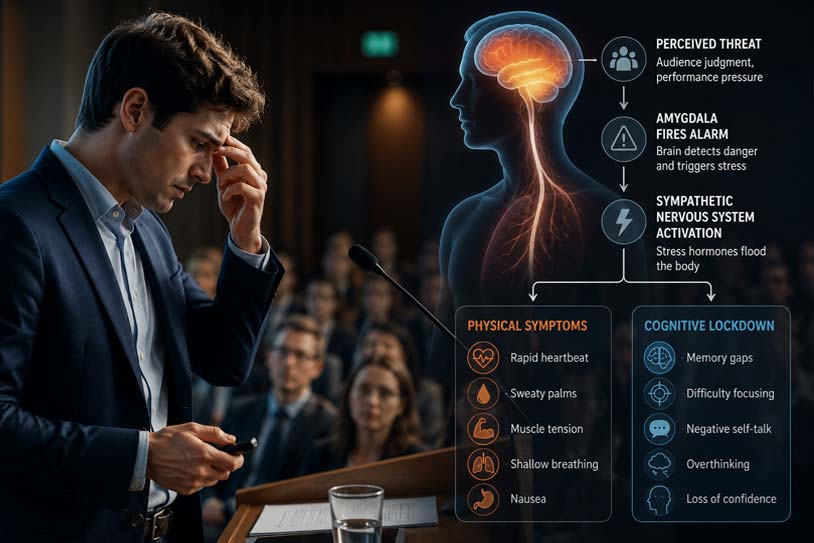
When you perceive a threat (like an audience’s judgment), your amygdala—the brain’s emotional radar—fires instantly. It doesn’t care if the threat is a saber-toothed tiger or a PowerPoint presentation; it triggers the sympathetic nervous system, flooding your body with cortisol and adrenaline.
[Perceived Threat: Audience Judgment]
│
▼[Amygdala Fires Alarm]
│
▼[Sympathetic Nervous System Flood]
┌─────────────┴─────────────┐
▼ ▼[Physical Symptoms] [Cognitive Lockdown]
• Cold hands/shaking • Memory gaps
• Tense muscles • Circular rumination
This survival loop causes two major disruptions:
- Vascular Shunting: Your body pulls blood away from your extremities (leaving you with Cindy’s “cold hands”) and redirects it to your major muscles so you can run or fight.
- Prefrontal Shutdown: The rush of stress hormones temporarily impairs the prefrontal cortex—the area of your brain responsible for working memory and complex thought. This is why you suddenly forget a piece of music you’ve played a thousand times, or blank on a slide you spent all night reviewing.
Redefining Your Relationship with the Stage
If stage fright is rooted in perfectionism, buried emotions, and a hyperactive survival response, how do we actually manage it? Modern performance psychology offers a roadmap to shift your mindset from dread to curiosity:
Shift from Perfection to Connection: Internal Mindset
Accept that perfection is a myth existing only in our fantasies. Your audience isn’t sitting there waiting to judge you with a microscope; they are actually rooting for you to succeed. Focus on delivering value or sharing a story, not putting on a flawless exhibition.
Treat Anxiety as a Signal, Not a Flaw: Emotional Curiosity
When your heart starts racing, don’t panic about panicking. Instead, get curious. Ask yourself: What is this physical tension trying to tell me right now? Am I afraid of failing? Am I angry about high expectations? Giving the emotion a name de-escalates the amygdala.
Ground the Physical Body: Somatosensory Reset
Because performance anxiety shunts blood flow and tenses muscles, actively counteract it. Use progressive muscle relaxation (tensing and releasing muscle groups) or try “box breathing” (inhale for 4 seconds, hold for 4, exhale for 4, hold for 4) to manually signal to your nervous system that you are safe.
Performance anxiety isn’t proof that you are untalented, incapable, or weak. It is simply a sign that your mind and body are highly invested in the moment—and perhaps carrying some old, unexamined emotional baggage into the spotlight. The next time you feel the pre-show jitters, don’t try to fight them or push them down. Take a deep breath, acknowledge the hidden emotions speaking through your nerves, and remember that the audience is just waiting to connect with a human being, not a robot.
“Performance anxiety isn’t a sign that you’re unprepared—it’s often a sign that your mind is trying to protect you from fears you’ve never fully addressed.
By Deepak Santhiraj, Licensed Clinical Social Worker
Recent Posts

Interviewing Your Intentions
If you are a born procrastinator, you’ve likely spent a lifetime hunting for a surefire formula to start, stick [...]

Why Couples Argue More When Life Slows Down
When schedules slow down, many couples expect life to feel easier, calmer, and more connected. Fewer obligations, less rushing, [...]

Why Summer Makes Family Conflict and Couples Stress Show Up Faster
Summer is often associated with vacations, longer days, and more time spent with loved ones. Many families look forward [...]