
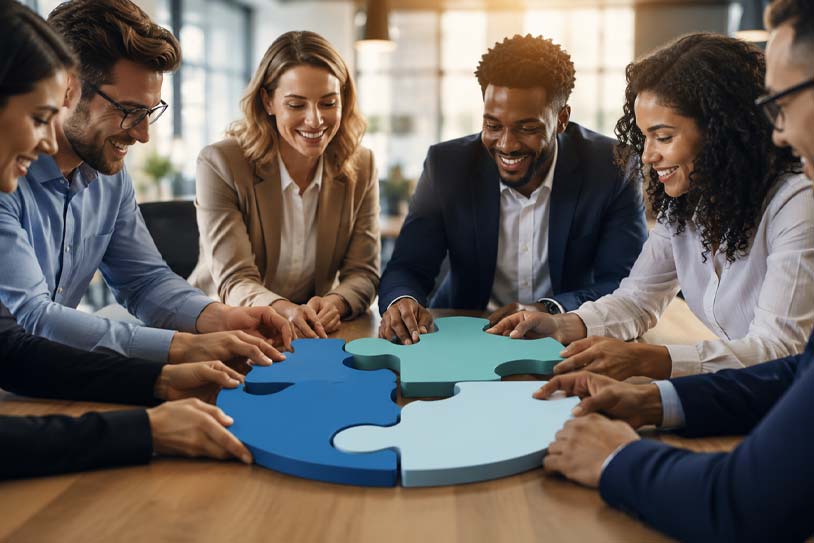
There is a foundational truth in modern organizational psychology: a team’s success relies heavily on its Emotional Intelligence (EI). While a high group IQ ensures a team possesses technical talent, it is the collective EI that determines whether members can effectively coordinate that talent.
When individual EI metrics are scaled up to the group level, they form what researchers call Group Emotional Competence (GEC). This collective competence creates an environment rich in psychological safety, driving collaboration and overall performance.
Collaborative Efficiency & Cohesion
High-EI teams collaborate better and navigate internal dynamics smoothly. A comprehensive meta-analysis published in the Journal of Organizational Behavior evaluated data from thousands of working teams. The researchers established a statistically significant, positive correlation between team-level EI and objective job performance. High-EI teams spend less time decoding ambiguous social cues or managing passive-aggressive friction. This efficiency directly optimizes cognitive load, allowing the team to dedicate more mental bandwidth to problem-solving and innovation rather than navigating interpersonal politics.
Emotional Regulation and Crisis Management
Teams with high EI can effectively process stressful setbacks without derailing into panic or shifting blame. This capability relies heavily on affective regulation—the structural ability of a group to alter its emotional state to fit the demands of a high-stress situation. According to the Group Emotional Competence model, high-EI teams actively build norms that balance personal and social dynamics: When a high-EI team experiences a major operational setback, instead of defaulting to a fear response, members rely on structured habits. They acknowledge the stressor collectively, evaluate the issue objectively, and shift focus toward problem-solving. This approach mitigates the risk of workplace burnout and prevents acute operational fatigue.
High-Constructive Conflict Resolution
Low-EI teams typically alternate between two harmful extremes: total artificial harmony (where critical feedback is withheld) or destructive personal attacks. High-EI teams use conflict productively. A classic corporate frameworks divide workplace friction into two distinct categories:
- Task Conflict: Healthy disagreements centered around job assignments, strategic approaches, and creative ideas.
- Relationship Conflict: Interpersonal friction, animosity, and personality clashes.
The Mechanism: High-EI teams possess the social awareness necessary to preserve this boundary. They can challenge a strategy aggressively (high task conflict) while maintaining mutual respect, which prevents the discussion from degrading into a personal dispute (low relationship conflict).
The Catalyst for Psychological Safety
A central premise is that high emotional intelligence helps build deep mutual trust. In modern organizational research, this dynamic is understood as the foundation of psychological safety. Pioneering research by Dr. Amy Edmondson demonstrates that psychological safety is the single greatest predictor of success in high-velocity teams.
Psychological safety is not a generic state of “being nice.” Rather, it represents a shared belief that the team environment is entirely safe for interpersonal risk-taking. Team members feel comfortable admitting errors, asking for help, or proposing unconventional ideas without fearing ridicule, social rejection, or professional retaliation.
Comparative Analysis: Team Dynamics
To understand how these concepts manifest in daily operations, consider the distinct behavioral differences between teams operating at opposite ends of the emotional intelligence spectrum:
| Operational Metric | Low-EI Teams | High-EI Teams (High GEC) |
| Feedback Loop | Avoided or delivered punitively; creates defensive reactions. | Continual, objective, and oriented toward personal and group growth. |
| Meeting Dynamics | Dominated by loudest voices; safe or superficial compliance. | Structured, inclusive turn-taking with active listening. |
| Mistake Management | Finger-pointing, blame-shifting, and concealment of errors. | Post-mortem analysis focused on systemic improvement. |
| Adaptability | Rigid resistance to sudden strategic pivots or changes. | Agile responses driven by collective emotional resilience. |

Developing Team EI
Building a team’s emotional intelligence requires deliberate changes to operational habits and communication norms.
Establish Explicit Norms for Interpersonal Interaction: Phase 1: Groundwork
Co-create written guidelines for team behavior. These should explicitly mandate behaviors like avoiding interruptions, ensuring equitable participation during discussions, and utilizing objective frameworks for resolving professional disagreements.
Integrate Systematic Emotional Check-Ins: Phase 2: Awareness
Begin high-stakes strategy sessions with brief, objective alignment checks. For example, use a simple quantitative scale (e.g., green, yellow, red bandwidth indicators) to assess the team’s current stress level and overall focus before diving into complex tasks.
Implement Structured Conversational Turn-Taking: Phase 3: Inclusion
Actively design meeting formats to disrupt the tendency for a few individuals to dominate discussions. Use structured roundtables or silent brainstorming sessions to ensure the team benefits from all available expertise and perspectives.
Conduct blameless operational post-mortems: Phase 4: Optimization
When operational failures occur, conduct reviews focused entirely on process improvement rather than assigning personal blame. Ask “What flaw in our system or workflow allowed this mistake to happen?” rather than “Who is responsible?”
Without the emotional intelligence required to initiate, navigate, and resolve difficult conversations, teams naturally default to conflict avoidance or lean on Human Resources to mediate standard interpersonal friction. Transforming workplace tension into constructive dialogue requires a suite of EI competencies—including self-regulation and empathy to move past defensive posturing and engineer true win-win outcomes for everyone.
“A team’s greatest advantage isn’t just the intelligence of its members—it’s their ability to understand, manage, and work through emotions together.
By Deepak Santhiraj, Licensed Clinical Social Worker
Recent Posts

Fine. We’ll Talk About It Next Year
There was a different version of this article. It was a lot more fun to write. You won't be [...]

Setting Boundaries
Setting boundaries is simple in concept: saying "no" to requests that conflict with your values preserves your finite time, [...]

What to Do When Your Teen Refuses Counseling
You've noticed changes. Your teenager spends more time alone, gets overwhelmed by school, or seems angry almost every evening. [...]